

Model Overview
GLM-5.3-Flash/GLM-5.3-FlashX is the first native multimodal model in the GLM-5 series, delivering stronger intelligence than GLM-5.2 at an exceptionally low cost.- Highly Efficient Hybrid Architecture
- Native Multimodal Visual Coding
- A Professional Work Partner Beyond Coding
Input Modality
Video / Image / Text / File
Output Modality
Text
Context Length
1M
Maximum Output Tokens
128K
How to Use
Model API
- Model Code:
glm-5.3-flash/glm-5.3-flashx - API Documentation:Chat Completion API
- Parameter Settings:Text parameters are consistent with GLM-5.3, with support for a 1M-token context window.
- Image Parameters:Add a content block with
type: image_urltomessages[].content[], and pass the image URL (recommended) or a Base64 Data URL throughimage_url.url. Multiple images can be added by including multipleimage_urlcontent blocks. - Recommended Settings:
temperature: 1,top_p: 0.95, andreasoning_effort: max.thinking.typeonly supportsenabled; we recommend settingthinking.clear_thinking: false. For streaming requests, we recommend enabling both stream: true andtool_stream: true.
GLM Coding Plan
- Now fully available, GLM-5.3-Flash can be used with your preferred tools, with 3× the available quota compared with GLM-5.3. (GLM-5.3-FlashX is not yet available on the plan)
- The new GLM Coding Plan adopts a points-based quota system with transparent usage limits. Model calls made during off-peak hours, including all day on weekends, consume only 50% of the standard points.
Subscribe now: Personal Plan、Team Plan
Capabilities
- Thinking Mode: Provides multiple thinking modes to address different task requirements.
thinking.typeonly supportsenabled; thinking cannot be disabled. - Streaming Output: Supports real-time streaming responses for an enhanced user interaction experience.
- Function Calling: Provides powerful tool-calling capabilities and supports integration with a wide range of external tools.
- Context Caching: Uses an intelligent caching mechanism to optimize long-conversation performance.
- Structured Output: Supports structured output formats such as JSON for seamless system integration.
- Visual Understanding: Native multimodal input supporting images, videos, and files.
Best Practices
Vision-Driven UI Coding: From Reference Assets to a Complete Application
Vision-Driven UI Coding: From Reference Assets to a Complete Application
GLM-5.3-Flash can directly transform screenshots, multiple page images, website URLs, or screen recordings into polished, functional applications. It goes beyond reproducing colors and layouts by understanding page relationships, shared components, design systems, interaction states, and animation logic, enabling an end-to-end workflow from visual analysis to a complete frontend project.Recommended Approach:
Provide a set of page screenshots from the same product, or a website with complex animations, and have the model create a high-fidelity reproduction:
Based on the page screenshots I provide, fully recreate this product using Next.js and TypeScript. First analyze the design system, page relationships, shared components, navigation structure, interaction states, and animation logic, then build a fully functional project. After implementation, launch the project and compare screenshots of each page against the reference images. Continuously refine differences in layout, typography, spacing, colors, image cropping, and interactions. Finally, explain which pages have been covered, how to run the project, and any remaining discrepancies.
Office Deliverables: From Content Organization to Visual Validation
Office Deliverables: From Content Organization to Visual Validation
GLM-5.3-Flash’s Office capabilities go beyond content generation to simultaneously handle information structure, visual styling, charts, image cropping, and page layout. Whether creating PPTX, PDF, DOCX, or XLSX files from scratch or reproducing existing files and reference images, it can proactively identify issues such as overflow, misalignment, overlapping elements, and inconsistent styling through rendering and visual inspection.Recommended Approach:
Select a real presentation or reporting task, clearly specify the audience, page count, content structure, and visual style, and have the model deliver a ready-to-use file:
Using the materials in the current directory, create a 15-page business presentation for management. First extract the key conclusions and narrative structure, then create editable charts, page layouts, image selections, and speaker notes. Do not fabricate any business data; cite the source for all referenced information. After completion, render and inspect each page, fixing text overflow, image cropping, element overlap, alignment issues, and visual inconsistencies. Finally, deliver the PPTX and PDF, and explain what has been verified and what risks remain uncovered.
Financial Professional Workflows: From Research Traceability to Models and Reports
Financial Professional Workflows: From Research Traceability to Models and Reports
GLM-5.3-Flash covers the complete workflow from financial research and analysis to valuation modeling and report generation. It can integrate information from multiple sources, retain the supporting evidence for key conclusions, distinguish disclosed facts from analytical assumptions and derived results, and translate research insights into auditable financial models and formal reports.Recommended Approach:
Select a listed company that has just released its latest financial results, and provide its announcements, financial statements, and an existing model:
Based on the company’s latest financial statements, announcements, and verifiable public information, conduct a comprehensive earnings analysis. Break down revenue, profit, cash flow, business segments, and key operating metrics, clearly distinguishing between company disclosures, analytical assumptions, and your own conclusions. Update the earnings forecast and valuation model, and verify the consistency of the three financial statements, formula references, and accounting definitions. Finally, deliver a PDF research report with source citations and an editable, formula-driven Excel model, and list the key risks and unverified information.
Video Understanding and Editing: From Long-Form Footage to Publish-Ready Videos
Video Understanding and Editing: From Long-Form Footage to Publish-Ready Videos
In an Agent environment, GLM-5.3-Flash can simultaneously understand visuals, speech, subtitles, relationships between people, and timelines, reorganizing long-form videos or multiple pieces of footage into coherent content. It can also leverage name tags, on-screen appearances, and contextual cues to continuously identify different speakers, handling tasks such as speaker attribution, story structuring, and visual matching that are difficult to accomplish with ASR alone, significantly improving the efficiency of video editing Agents.Recommended Approach:
Provide a set of interview, event, or product footage and have the model complete the editing, subtitles, and final quality checks:
Edit the videos in the footage directory into a 90-second product launch recap. First create a media inventory, identify people, events, key statements, and usable shots, then design the pacing of the opening, main section, and ending. Distinguish between speakers and generate accurate subtitles, ensuring that the visuals correspond to the spoken content. After completing the editing, music, transitions, and basic color grading, check for typos, speaker attribution, audio-video synchronization, black frames, and duplicate shots. Finally, output the MP4, SRT, and editing notes.
3D Scene Creation: From a Single Description to a Complete Blender Project
3D Scene Creation: From a Single Description to a Complete Blender Project
GLM-5.3-Flash can transform spatial requirements, visual styles, and functional constraints into editable Blender projects, and continuously develop them from blockout to assets, materials, lighting, camera setup, and final rendering. More importantly, it can repeatedly render from fixed camera positions, inspect the actual visuals, identify issues, and iterate, rather than merely generating a modeling script.Recommended Approach:
Provide a complete scene task that specifies spatial planning, design style, and delivery requirements:
Create a complete, editable Blender scene in the current directory depicting a restaurant and bar located on a high floor in a city. First define the artistic direction, spatial layout, asset list, and fixed camera shots, then build the blockout and render previews as early as possible. Perform at least four rounds of “build → fixed-camera render → inspect → refine → re-render,” focusing on spatial scale, circulation, materials, lighting, mesh intersections, and camera composition. Finally, reopen the project from a clean environment and render the main shot. Deliver the .blend file, final images, and reproduction instructions.
Game Development: From Gameplay Rules to a Fully Playable Loop
Game Development: From Gameplay Rules to a Fully Playable Loop
GLM-5.3-Flash can extract visual language, core mechanics, state machines, and win/loss conditions from reference images and gameplay descriptions, efficiently adapt them to professional cross-platform game engines such as Godot, and implement them as genuinely playable game prototypes. Rather than simply generating scenes, it is better suited to testing whether movement, collisions, AI, scoring, levels, results, and save systems form a complete gameplay loop.Recommended Approach:
Use your own or properly licensed assets and choose a focused, time-bounded Godot game task:
Using the properly licensed assets in the current directory, develop a playable cooperative cooking game prototype with Godot 4. First review the gameplay specifications, asset mappings, and reference screenshots, then implement character movement, item pickup, food preparation, serving, scoring, countdown timers, and the results flow according to milestones. Run tests after each stage and compare the result against the reference images using the same map and camera positions. Finally, ensure that a complete game session can run from start to finish, and deliver the Web build, test logs, runtime instructions, and a list of incomplete items.
Computer Use Closed Loop: Operating, Testing, and Refining in Real Interfaces
Computer Use Closed Loop: Operating, Testing, and Refining in Real Interfaces
GLM-5.3-Flash can visually understand software interfaces and perform clicks, text input, decision-making, and continuous actions even when structured APIs are unavailable. It can test games and websites, observe existing applications, reproduce key functionality, and then operate the reproduced version to identify discrepancies, forming a closed loop of “observe → implement → use → refine.”Recommended Approach:
Select a local application or web product, enable
/goal mode, and have the model reproduce it while using it:
/goal Use Computer Use to inspect the currently open application, identify its page structure, core functionality, primary user flows, and interaction feedback, and recreate a functional version in the current directory. After completion, operate both the original application and the recreated version, comparing their layouts, functionality, state changes, and interaction paths. Record the differences and continuously improve the implementation. Finally, complete all major workflows except login, and provide the verification results, remaining discrepancies, and instructions for running the application.
CAD Visual Reproduction: From Design Blueprints to Editable 3D Models
CAD Visual Reproduction: From Design Blueprints to Editable 3D Models
GLM-5.3-Flash can understand the main structure, hole positions, fillets, chamfers, surfaces, and assembly relationships from part photographs, sketches, or CAD blueprints, and generate parametric 3D models using code-based tools such as build123d. After generating the model, it can render multiple views, continuously compare them against the reference images, refine discrepancies, and deliver editable project assets for further development.Recommended Approach:
Select a mechanical part with a clear structure and multiple recognizable features, and provide dimensional or proportional references:
Based on the part blueprint and multi-angle reference images I provide, use build123d to write parametric code that recreates the part. First identify the main structure, key dimensions, hole positions, fillets, chamfers, and symmetry relationships, and list assumptions for any dimensions that cannot be determined with certainty. After completion, render the model from angles matching the reference images and compare the proportions and structural differences item by item, continuously refining the model. Finally, deliver the Python source code, STEP file, STL file, dimensional specifications, and an interactive viewing page.
Key Advancements
GLM-5.3-Flash incorporates several architectural improvements over GLM-5. For the first time, we introduce a hybrid architecture combining sparse and linear attention, sharply reducing long-context serving costs while preserving precise long-context capabilities. It also adopts Manifold-Constrained Hyper-Connections (mHC) to further improve scaling efficiency. Combined with our latest 30T-token multimodal pre-training corpus, these changes let GLM-5.3-Flash produce more intelligence with less compute. Before release, we tested GLM-5.3-Flash anonymously as ox-alpha on OpenCode and OpenRouter to gather user feedback. It quickly became the most popular model of the week — with all of this traffic served on Chinese AI chips.Competitive Performance at Flash Cost
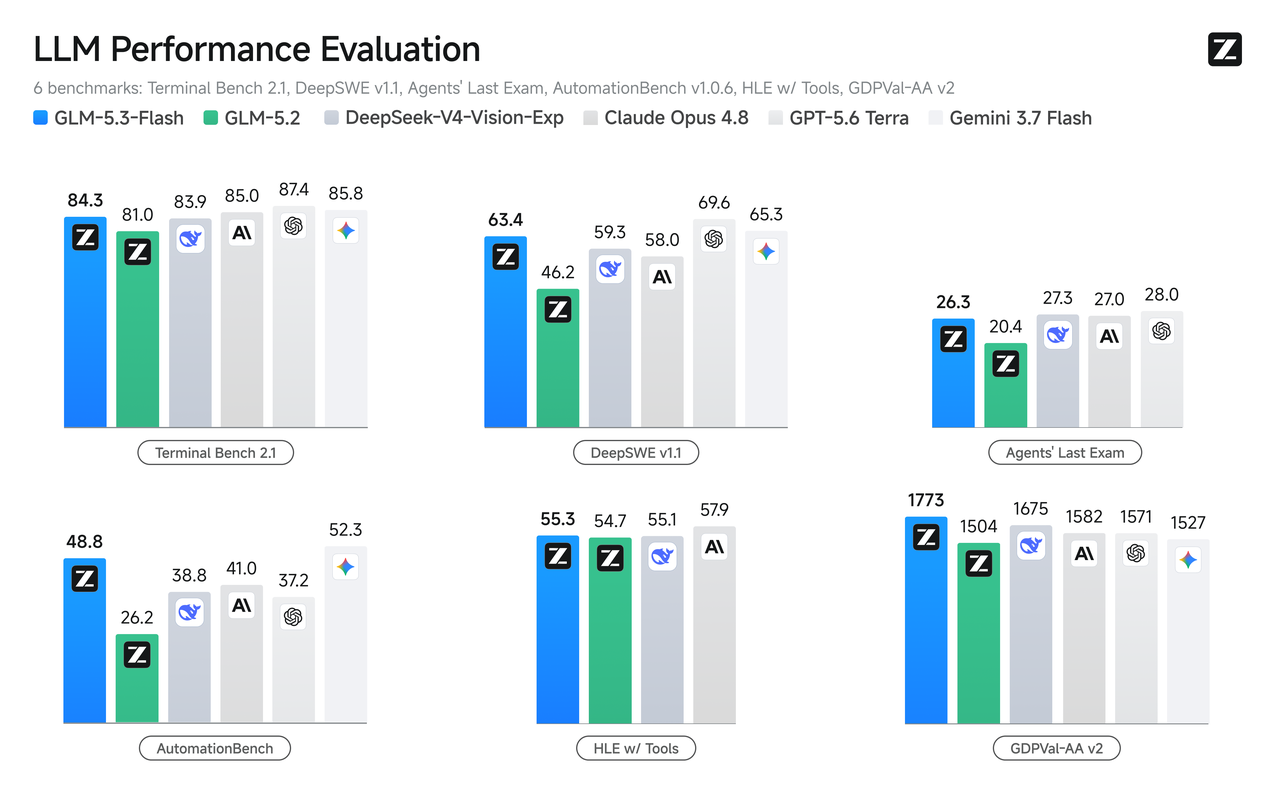
GLM-5.3-Flash pushes the Pareto frontier of the Artificial Analysis Intelligence Index v4.1.1, scoring 57 at just $0.045 per task (discounted) — a level of intelligence previously only available at roughly 10× the cost. This makes it a highly competitive default choice for a broad range of workloads.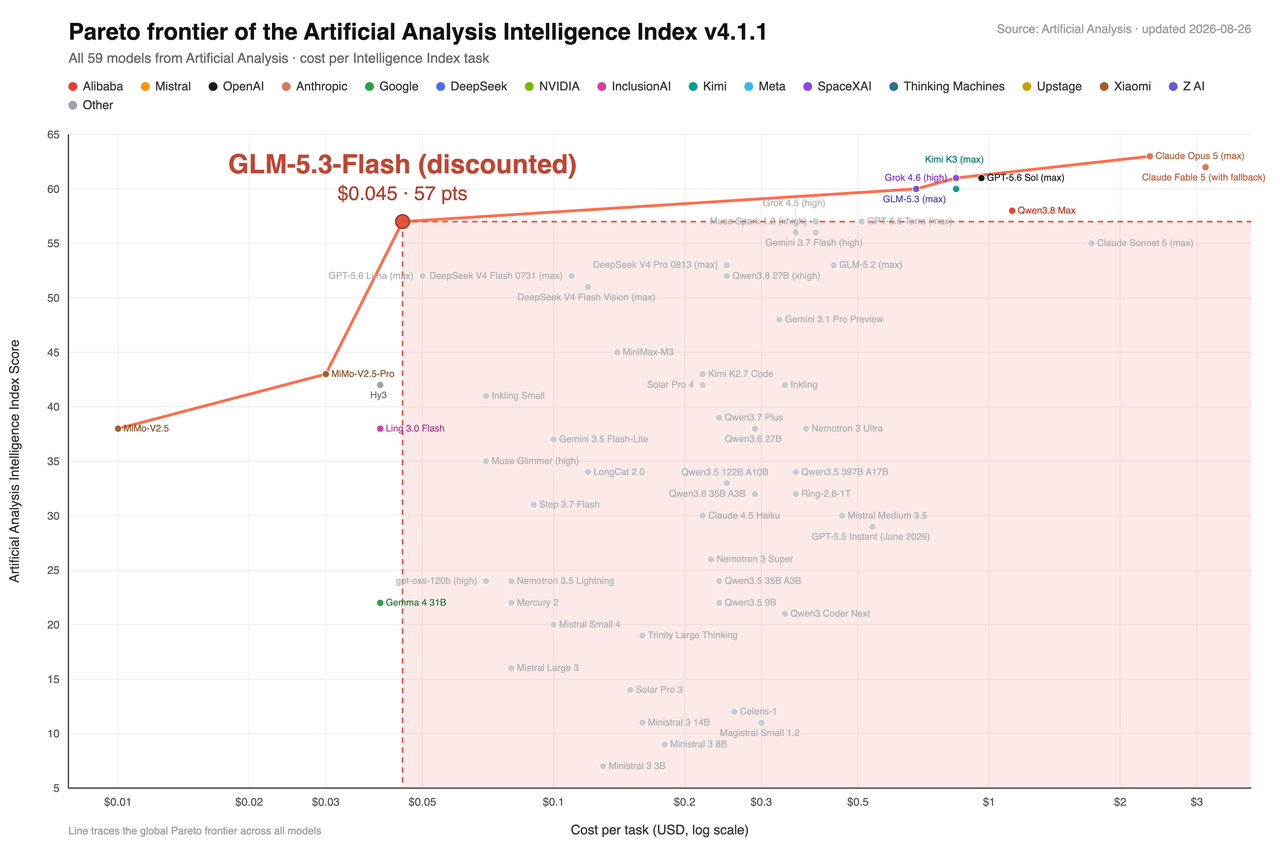 Across six coding and agentic benchmarks, GLM-5.3-Flash consistently outperforms GLM-5.2, often by a wide margin — 63.4 vs. 46.2 on DeepSWE v1.1 and 48.8 vs. 26.2 on AutomationBench — while approaching Claude Opus 4.8 overall.This holds on our in-house coding evaluation as well: on Z.ai Code Bench v1.0 (run on Claude Code 2.1.207), GLM-5.3-Flash clearly outperforms GLM-5.2 at every effort level, and at max effort nearly matches Claude Opus 4.8 (29.0 vs. 29.5).
Architecture for Extreme Efficiency
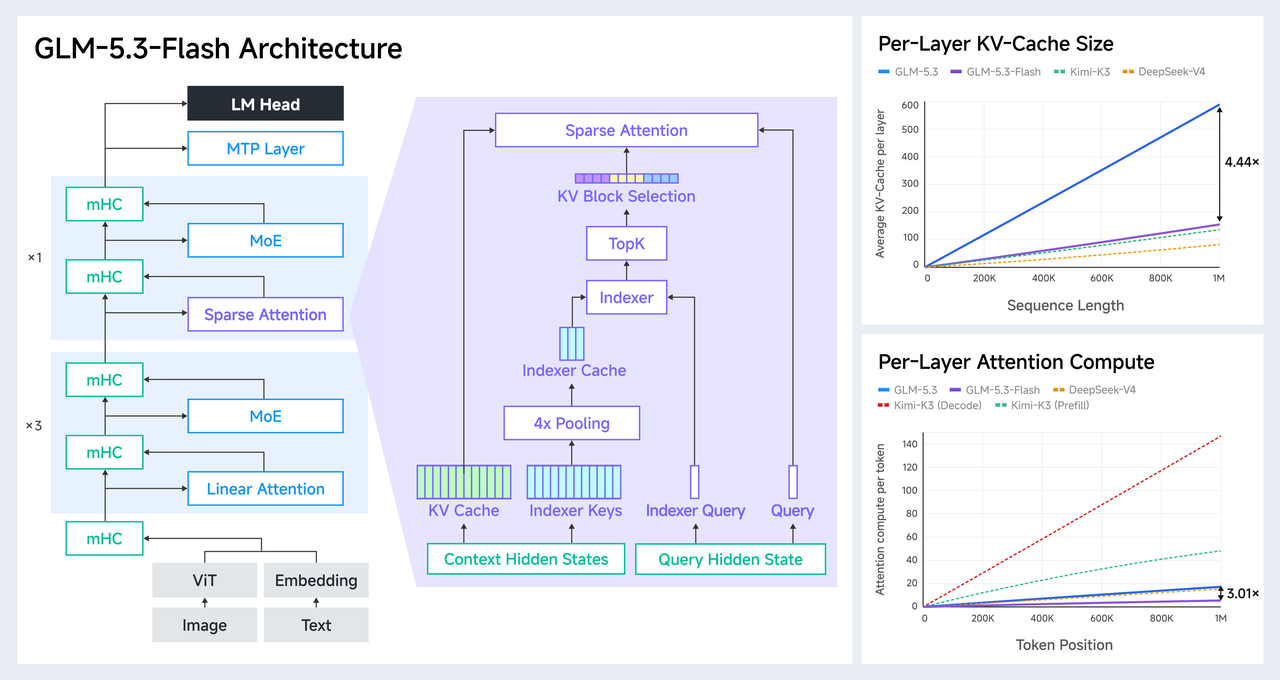 GLM-5.3-Flash is specifically designed for ultra-low-cost inference. Despite a similar total parameter count (320B vs. 355B), it nearly halves both the activated parameter count (18B vs. 32B) and the number of layers (45 vs. 92).
To minimize attention costs in long-context scenarios, we use a hybrid architecture combining linear and sparse attention. Linear attention captures local dependencies through state modeling, while sparse attention retrieves relevant global context through a lightweight indexer. To further reduce the latency and memory overhead of the indexer at a 1M-token context length, we introduce IndexPool, which compresses four indexer key vectors into one through weighted pooling.
To illustrate the efficiency of our architecture, we compare the per-token compute and KV cache size of GLM-5.3-Flash against GLM-5.3 and two recent open models DeepSeek-V4-Flash and Kimi-K3. For a fair comparison among different scales, we calculate the attention compute per head per layer and average KV cache size per layer (BF16). Compared with GLM-5.3, GLM-5.3-Flash reduces the attention compute and KV cache size by factors of 3.0x and 4.4x. GLM-5.3-Flash has the lowest attention compute among all models compared. The KV cache size is still slightly larger than Kimi-K3 and DeepSeek-V4-Flash, leaving further room for improvement.
The overall architecture improvements, combined with optimized pre-training corpus, enable GLM-5.3-Flash to produce more intelligence with less compute. In the table below we show the evaluation results of the base model of GLM-5.3-Flash, comparing with our previous base models and DeepSeek-V4-Flash-Base. The results show that GLM-5.3-Flash-Base remains competitive with GLM-5-Base across most benchmarks.
GLM-5.3-Flash is specifically designed for ultra-low-cost inference. Despite a similar total parameter count (320B vs. 355B), it nearly halves both the activated parameter count (18B vs. 32B) and the number of layers (45 vs. 92).
To minimize attention costs in long-context scenarios, we use a hybrid architecture combining linear and sparse attention. Linear attention captures local dependencies through state modeling, while sparse attention retrieves relevant global context through a lightweight indexer. To further reduce the latency and memory overhead of the indexer at a 1M-token context length, we introduce IndexPool, which compresses four indexer key vectors into one through weighted pooling.
To illustrate the efficiency of our architecture, we compare the per-token compute and KV cache size of GLM-5.3-Flash against GLM-5.3 and two recent open models DeepSeek-V4-Flash and Kimi-K3. For a fair comparison among different scales, we calculate the attention compute per head per layer and average KV cache size per layer (BF16). Compared with GLM-5.3, GLM-5.3-Flash reduces the attention compute and KV cache size by factors of 3.0x and 4.4x. GLM-5.3-Flash has the lowest attention compute among all models compared. The KV cache size is still slightly larger than Kimi-K3 and DeepSeek-V4-Flash, leaving further room for improvement.
The overall architecture improvements, combined with optimized pre-training corpus, enable GLM-5.3-Flash to produce more intelligence with less compute. In the table below we show the evaluation results of the base model of GLM-5.3-Flash, comparing with our previous base models and DeepSeek-V4-Flash-Base. The results show that GLM-5.3-Flash-Base remains competitive with GLM-5-Base across most benchmarks.